







Updated on April 2.
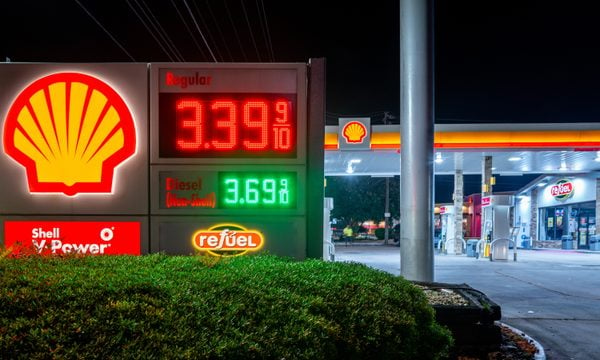
The average regular gas price in the U.S. as of April 2 is $4.081 per gallon, according to AAA.
- One week ago: $3.981
- One month ago: $2.997
- One year ago: $3.238
On Feb. 28, the first day of the U.S.-Israeli attacks on Iran, the average was just under $3.
Statewide averages range from $3.272 (Oklahoma) to $5.891 (California). On Feb. 28, the first day of the U.S.-Israeli attacks on Iran, the national average was just under $3.
Oil prices have skyrocketed since the start of the war as Iran vows to keep the Strait of Hormuz closed to “enemy” shipping traffic.
In an address to the country on April 1, President Donald Trump said he expects the war to last another two to three weeks, and during that period the U.S. will hit Iran “extremely hard.”
The text and charts below are fully updated every Monday.
In the month since the U.S. and Israel launched strikes on Iran, the widening conflict has roiled global energy markets, shaken investor confidence and pushed average gas prices up by roughly a dollar.
Some analysts expect prices to cross $4 in the coming weeks.
Brent crude — the global benchmark — is trading around $100 per barrel. It traded below $70 as recently as mid-February and was below $80 when the conflict began. This is the first time oil has traded above $100 since 2022, when Russia invaded Ukraine. If the war continues into the summer, oil could reach $200 per barrel, according to analysts from Macquarie Group, an investment banking company.
Sustained prices of over $80, economists say, could reignite broader inflation and even spark global recession.
In early March, OPEC+ announced it would increase production in April by 206,000 barrels per day, which could provide a buffer. But oil won’t reach markets if traffic does not resume through the Strait of Hormuz, the passageway for roughly a fifth of the world’s oil, which Iran says is closed to its “enemies,” i.e. the U.S. and its allies.
In his speech on April 2, Trump said, “When this conflict is over, the strait will open up naturally. It’ll just open up naturally. They’re going to want to be able to sell oil because that’s all they have to try and rebuild. It will resume the flowing and the gas prices will rapidly come back down.”
The strait won’t necessarily “just open up naturally” if and when the conflict ends. Iran has the ability — and likely the incentive — to control the flow, and that could keep gas prices higher for some time.
The U.S., despite being the world’s largest producer of oil, can see gas prices rise in response to any shock to the world’s oil supply.
» Nerd out with us! Take our quick reader survey to help us give you a better, Nerdier experience.
What are gas prices like right now?
As of April 2, gas prices are climbing rapidly, according to AAA, which tracks fuel costs. Gas prices are now above $3 in all states and the nationwide average is above $4. They were below $3 in 39 states a month ago.
Refineries are beginning to switch back to producing a summer blend, which is more expensive than the winter blend, which could contribute to rising prices soon.
The U.S. Energy Information Administration says the falling price of crude oil — accounting for half of retail gas prices — helped lower prices at the pump in 2025. On a monthly average basis, the price of Brent crude oil dropped from $79 per barrel in January 2025 to $63 per barrel in December 2025 — its lowest average monthly price since the start of 2021, according to the EIA.
Pump prices were stable over the summer and fell in the fall and winter, especially compared to recent years. Oil prices moderated at around $65 a barrel after spiking briefly in June 2025 in response to the Israel-Iran conflict, and were below $60 at the beginning of the year. They have risen sharply in the past few weeks.
» Stay informed:
- Check out NerdWallet's news hub for all the latest.
- Subscribe to one of NerdWallet's free newsletters.
Meet MoneyNerd, your weekly news decoder
So much news. So little time. NerdWallet's new weekly newsletter makes sense of the headlines that affect your wallet.
Gas price inflation, explained
Gas prices surged in 2021 and 2022, largely due to two economic disruptions: pandemic-related supply shocks and then Russia’s invasion of Ukraine. The combination of the two hit energy markets hard and prices never recovered to pre-pandemic levels.
Here’s what happened:
- In 2019, before the pandemic, the average per-gallon price of regular gas was $2.601, according to EIA data.
- Following Russia’s invasion of Ukraine, the national average increased before peaking at $5.016 per gallon on June 14, 2022, according to AAA.
- Until the Iran invasion, gas prices had retreated, but hadn’t returned to pre-pandemic levels.
Why gas prices remain higher than they used to be
At this time of year, seasonal factors play a considerable role in raising gas prices. A scheduled switch to summer-blend gasoline temporarily elevates prices through the warm months. Inflation, supply-chain disruptions and gas tax hikes can factor into higher prices, as well. But in the end, elevated oil prices are the main culprit.
The cost of oil typically represents more than half of the cost of a gallon of gasoline, according to the U.S. Energy Information Administration (EIA). So, a major reason gas prices have remained so high is that, until recently, oil prices were higher than they were before the pandemic hit in 2020 and Russia invaded Ukraine in 2022. That’s based on the average monthly price of West Texas Intermediate crude, which is used as the benchmark for oil prices in North America.
For much of the year to date fuel costs had been lower than they were a year ago. That has changed dramatically in the last few weeks. Here’s how gas prices compare today:
As of April 2, the average regular gas price in the U.S. is $3.990 per gallon, according to AAA, which tracks gas prices.
- The price is up from $3.981 a gallon a week ago.
- The price is up from $2.997 per gallon a month ago.
- A year ago, the price was $3.238 per gallon.
Oil prices are still below their June 2022 peak of almost $120 per barrel.
Average gas price per state
The average gas price per state varies widely, with the most expensive state typically costing about $2 more per gallon of regular than the least expensive state.
(Photo by Majid Saeedi/Getty Images)
Article sources
NerdWallet writers are subject matter authorities who use primary,
trustworthy sources to inform their work, including peer-reviewed
studies, government websites, academic research and interviews with
industry experts. All content is fact-checked for accuracy, timeliness
and relevance. You can learn more about NerdWallet's high
standards for journalism by reading our
editorial guidelines.