




Let’s say a hurricane is bearing down on Florida’s southeast coast. If you live there, you might check the National Weather Service, watch for evacuation orders or look out your window to monitor the situation.
But hey, it’s 2026 — why not see what the prediction market says?
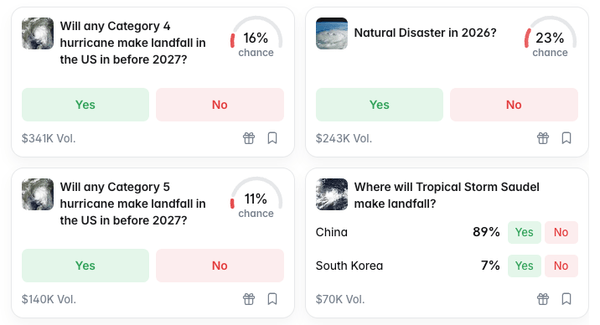
Prediction markets like Kalshi and Polymarket show how much traders are willing to pay for contracts (essentially bets on whether a particular event will happen) tied to extreme weather events and natural disasters, such as whether a Category 4 hurricane will make landfall in the U.S. before 2027, the number of tornadoes this month or how many 7.0 or above earthquakes there will be this year. They also offer contracts tied to other catastrophic events, like the potential for future pandemics.
Betting on extreme weather that may result in property damage, injuries and deaths may seem strange, even callous. Yet prediction markets tied to these events are expanding. As of publication, there are more than 100 active weather-based predictions on Kalshi and roughly 500 on Polymarket.
Critics say natural disaster markets turn human pain into a financial opportunity and could even create incentives to manipulate events that cause real-world harm.
“It seems just particularly ghoulish to bet on these catastrophic natural hazards in which lives and property are lost in the same sort of dashboard that you might bet on ‘When will Taylor Swift release her next album’ or ‘Who will win the World Cup,’” says Jamie Pietruska, associate professor of history at Rutgers University who is writing a book about weather capitalism and gambling. “It’s this kind of casualization of catastrophe.”
Proponents, meanwhile, say the markets aren’t simply gambling; they argue that putting money behind predictions can create a new source of information about risk beyond traditional models.
“You set up the markets, and whoever figures out that they have information comes in and trades and informs the prices,” says Robin Hanson, associate professor of economics at George Mason University.
Essentially, Hanson says that prediction markets may surface information that would be difficult for any individual forecaster to gather on their own. That’s because people who may have their own models or information have an incentive to trade, and their trades collectively move the market’s forecast.
How natural disaster markets work
Back to that hurricane example. On a prediction market, a contract asking whether a Category 4 hurricane will make landfall is trading at 30 cents. That price implies traders see roughly a 30% chance of the event happening.
To a casual observer, it might look just like a weather app forecast. But the number comes from people buying and selling contracts, not from a weather model. That market probability reflects what traders collectively believe will happen and that’s reflected in the price: A contract trading at 30 cents implies a 30% probability of the event occurring.
Meet MoneyNerd, your shortcut to smart money moves
NerdWallet's twice-weekly newsletter offers practical, no-fluff guidance to help you spend smarter, save more, and make confident money decisions. Delivered free to your inbox.
“Market probabilities are just very well calibrated,” Hanson says. “So, on average, when a market says 70%, seven out of 10 times, it'll happen that way.”
Weather can be especially difficult to bet on because conditions can change quickly. If the hurricane is expected to make landfall as a Category 4, it could weaken to a Category 3 before it reaches land. Or winds could shift and take it further out to sea and never make landfall at all. If the contract calls specifically for a Category 4 landfall, the trader loses the bet.
The promise and limits of prediction markets
The inherent unpredictability of weather begets a bigger question: Could prediction markets actually complement traditional forecasting models or even improve on them?
“Financial markets in general, not just prediction markets, get people to put the extra work in to find out more,” Hanson says. “Weather forecasts are based on a limited effort and they can't do everything. They do their best — and I'm not saying they do it wrong — but it's based on how much work they put in. You put in more work, you can do better, right?”
Pietruska is more skeptical about the credibility of prediction markets in forecasting. “It’s not a truth machine," Pietruska says. “It’s aggregating public opinion. Some people may be informed and some people may not be, but I don’t think it is as reliable as the marketing would suggest.”
Jack Such, a spokesperson for Kalshi, says that prediction markets aren’t necessarily supposed to replace traditional forecasts. “Prediction markets are aggregators of information. That’s what makes them valuable,” Such says. He adds that markets generally don’t produce wildly different forecasts from established forecasting organizations. When they do diverge, however, the gap between the two forecasts may be worth paying attention to for bettors, forecasters or anyone else trying to gauge the likelihood of an event.
But usefulness is only part of the equation in disaster betting. These markets also surface a bigger ethical conundrum: What does it mean to put a price on events that can take lives, destroy homes and displace people?
The ethics of betting on disaster
In April, two suspicious temperature readings at Charles de Gaulle airport led to huge wins for two Polymarket users who had correctly anticipated the daily highs.
On April 6, a Polymarket user reportedly made nearly $14,000 when they bet on a sudden temperature spike to 21 degrees Celsius at Charles De Gaulle airport. A similar anomaly happened again on April 15 when the same sensor recorded another unexplained increase and a different Polymarket user turned a $119 bet into a more than $21,000 profit after betting that the temperature would reach 22 degrees Celsius.
The outcomes were unusual, to say the least. So unlikely were those readings that French authorities investigated whether the sensor had been deliberately tampered with (Reddit users suspect a blow dryer may have been used). Polymarket has since stopped using the sensor at Charles De Gaulle and switched to Le Bourget, a smaller airport nearby.
The episodes in Paris raise a broader question about the potential for perverse incentives when there’s money riding on an outcome. Tampering with a sensor is one thing, but critics say wildfire markets raise a more troubling possibility: that someone could commit arson or interfere with efforts to contain a fire.
Neither Kalshi nor Polymarket currently has an active wildfire market, as confirmed by representatives from both platforms. But last summer, Polymarket had offered contracts related to the August 2025 fires in Los Angeles, with more than $1.2 million wagered across markets.
“No one should be able to profit off the suffering of communities devastated by wildfires,” said Sen. Alex Padilla (D-CA) in a statement via email. “Betting on how long a fire will burn or how many homes it will destroy is unconscionable and risks creating dangerous incentives to interfere with or even start fires.”
Kalshi doesn’t offer wildfire markets for precisely that reason, Such explains. When it comes to information, Such says there’s little difference between wildfires and hurricanes. “But there is the difference that a human can't start a hurricane, but a human can start a wildfire,” Such says.
Prediction market platforms can still legally offer those contracts if they wanted to. The Commodity Futures Trading Commission (CFTC) has the authority to prohibit certain prediction market contracts, but has not specifically banned wildfire prediction markets.
However, Hanson argues that the media panic over manipulation for profit in these markets is overblown and the risk isn’t unique to prediction markets either. “In stock markets there's the question of ‘Will somebody sabotage a company in order to make money in the stock market?’” Hanson says. “So you could burn down a factory or poison some drug in order to make money after you had sold the company short and the price would go down. People have long worried about that, but apparently it almost never happens.”
There are documented examples of prediction market users who profited from bets involving nonpublic information — in this year alone, multiple suspicious bets were reported on markets involving U.S. military actions in Iran. In April 2026, a U.S. Army Special Forces master sergeant was charged by the Justice Department with using classified information related to the capture of Venezuelan President Nicolas Maduro in January to win more than $400,000 on Polymarket.
Neither Polymarket nor Kalshi allow markets that directly bet on loss of life in natural disasters — so you won’t be able to bet if 5,000 or 10,000 people die in a tsunami, for example. But Pietruska says that’s not the only concern.
“This focus on whether it’s a ‘death market’ seems to imply that, as long as it isn’t, then it’s just harmless gambling,” she says. “But I worry that framing preempts broader conversations about the continued weakening of government science, FEMA and emergency management, as well as the growing privatization of catastrophic risk management and disaster response.”
The future of disaster betting markets
Prediction markets could become more than a place for individual bettors to wager on the next hurricane or heat wave. As they grow, financial companies may also start to see markets as a source of information, as well as a potential new trading opportunity.
Pricing disaster risk isn't new. Insurers and reinsurers have been doing so for decades through catastrophe bonds, which pay investors a higher return if disaster doesn’t strike. Prediction markets are just the newer, shinier entrant into the space.
For now, both Kalshi and Polymarket activity is dominated by sports, with other markets — like natural disasters and extreme weather — comprising a significantly smaller slice. But that could change.
Pietruska questions how much institutional investors — insurers, reinsurers, hedge funds — are using prediction markets today. But there is some evidence that firms are getting positioned for growth in the space: The investment manager Moreton Capital Partners, for example, is looking for analysts to develop models for prediction market trading across categories that include “environmental events.”
There’s another side to that growth: The more people trade, the more platforms stand to make, potentially creating an incentive to add disaster-related bets. Pietruska says she’s concerned the transaction-fee model used by Kalshi may create an incentive to attract more traders and more opportunities to bet on disasters. “It’s a kind of disaster capitalism where disasters are literally good for business,” she says.
That dynamic, Pietruska argues, can make the markets feel particularly unsettling when the underlying events are increasingly common and consequential.
“We live in a climate-changed world, and there is something I think is particularly dystopian about staying inside on a terrible air quality day and betting on Polymarket on the air quality index,” Pietruska says.
Author’s note: A representative from Polymarket spoke on background for this article, but did not respond to requests for a statement on record.