











Love may not conquer all when it comes to finances: More than half of Americans (54%) say a partner not being truthful about their financial situation is a dealbreaker in a romantic relationship, according to a new NerdWallet survey.
The survey of more than 2,000 U.S. adults, conducted online by The Harris Poll in December 2025, found that Americans are split when it comes to red, yellow and green flag financial behavior in romantic relationships. And while lying about money is a big problem for some, plenty have done so in past and even current relationships.
Key findings
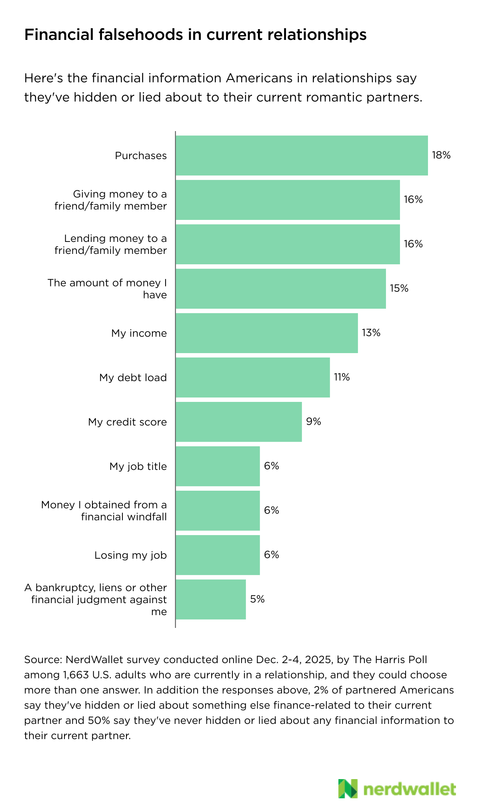
Half of Americans in a relationship (50%) say they’ve lied about or withheld financial information from their current romantic partner. The most common lie is about purchases (18%), followed by giving or lending money to a friend or family member (16% each).
Most Americans (86%) say at least one listed financial factor* would be a dealbreaker in a romantic relationship. Top listed dealbreakers are a partner not being truthful about their finances (54%) or asking to borrow money (46%).
Americans are split on which financial behaviors are red, yellow or green flags. While about half of Americans (47%) say suggesting low-cost dates is a green flag, 18% see it as a red flag and 36% say it’s yellow flag behavior.
“Long-term, a relationship isn’t going to survive on love alone,” says Sara Rathner, a credit card expert at NerdWallet. “When you’re combining your lives, how you handle money issues becomes really important.”
Money lies might cost you a relationship
Plenty of Americans may say lying about finances is a relationship dealbreaker, but money lies aren’t uncommon among couples. According to the survey, 52% of Americans say they’ve hidden or lied about financial information to a romantic partner in a previous relationship and 50% of Americans in a relationship have lied about financial information to their current partner. The most common mistruth is related to buying things: 18% of Americans currently in a relationship say they’ve lied about purchases to their partner.
If you’re holding something back from a partner, it’s probably a good idea to come clean, as long as it’s safe to do so.
“Everyone needs some autonomy within a relationship. It can be helpful to structure your finances in a way that you don’t have to check in every time you want to buy something. But if your individual decisions have a negative impact on your spouse or partner, telling them is the right thing to do,” Rathner says. “The exception is if you don’t feel safe admitting things to your partner. Your safety is the most important thing to consider.”
Anything for love? Not that
In our survey, we provided a list* of potential money-related dealbreakers in a romantic relationship and a whopping 86% of Americans identified at least one of them as a no-go.
Nearly half of Americans (46%) say a partner asking to borrow money from them is a dealbreaker, and 38% say the same thing about a partner typically expecting them to pay for dates. About a third of Americans (32%) say if a romantic partner lives with someone else — like family or roommates — it’s a dating dealbreaker.
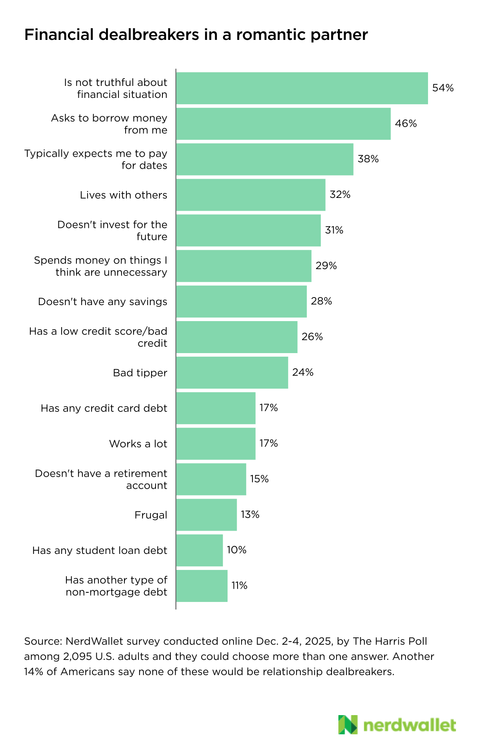
About 1 in 6 Americans (17%) say that a partner with any amount of credit card debt would be a dealbreaker. Paying off credit card debt quickly is a smart move; it can be costly due to high interest and eat up your monthly budget. Potentially becoming more dateable in the process is just the cherry on top.
“As it turns out, paying off credit card debt and improving your credit score don’t just make you more likely to qualify for better loans in the future. These actions can also help your dating prospects,” Rathner says. “But even if you are in debt, you’re likely to meet people who aren’t just understanding of your situation — they may also have credit card debt themselves.”
Making more is a green flag, but talking about it too much is a red flag
Lying about finances is pretty easy to identify as “bad” in relationships, but not everything is so cut and dried. Some money moves could be seen as good, bad or iffy, depending on your date.
For example, while 19% of Americans say a romantic partner talking about money early in a relationship is a green flag — or a positive — 42% say it’s a red flag — or a negative. The remaining 39% say it’s a yellow flag, which could be concerning, likely depending on the context.
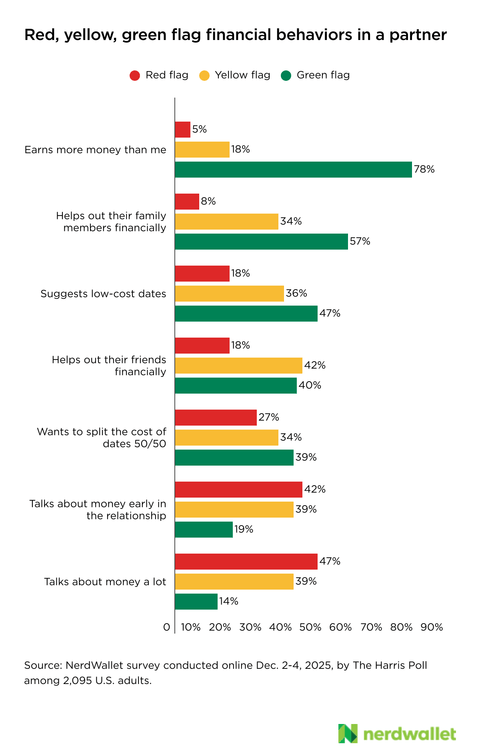
The financial behavior with the most even split is quite literally about splitting the bill. While 39% of Americans say a partner who wants to split the cost of dates 50/50 is a green flag, 27% say it’s a red flag and 34% say it’s a yellow flag.
Each of these money behaviors is pretty innocuous and probably wouldn’t be a dealbreaker in a compatible relationship. In fact, aside from financial abuse or infidelity, it’s likely that most dealbreakers highlighted throughout this study might just go out the window for the right person — as long as they’re willing to work together to build a bright financial future as a couple.
“The whole point of dating is figuring out if you’re compatible,” Rathner says. “If some kind of money issue gives either of you the ick, then at least it’s out there. You can discuss it and compromise, or set each other free to find a better match.”
Cite as NerdWallet (2026). “Survey: 17% of Americans Say Credit Card Debt is a Dating Dealbreaker.” Retrieved from https://www.nerdwallet.com/finance/studies/2026-dating-dealbreakers
Methodology
This survey was conducted online by The Harris Poll on behalf of NerdWallet from Dec. 2-4, 2025, among 2,095 U.S. adults ages 18 and older. The sampling precision of Harris online polls is measured by using a Bayesian credible interval. For this study, the sample data is accurate to within +/- 2.5 percentage points using a 95% confidence level. This credible interval will be wider among subsets of the surveyed population of interest. For complete survey methodology, including weighting variables and subgroup sample sizes, please contact [email protected].
*These are the financial factors that we provided survey respondents as possible dating dealbreakers:
Is not truthful about financial situation.
Asks to borrow money from me.
Typically expects me to pay for dates.
Lives with family members or roommates.
Doesn’t invest for the future.
Spends money on things I think are unnecessary.
Doesn’t have any savings.
Has a low credit score/bad credit.
Bad tipper.
Has debt (any credit card debt, any student loan debt, another type of non-mortgage debt).
Works a lot.
Doesn’t have a retirement account.
Frugal.
Disclaimer
NerdWallet disclaims, expressly and impliedly, all warranties of any kind, including those of merchantability and fitness for a particular purpose or whether the article’s information is accurate, reliable or free of errors. Use or reliance on this information is at your own risk, and its completeness and accuracy are not guaranteed. The contents in this article should not be relied upon or associated with the future performance of NerdWallet or any of its affiliates or subsidiaries. Statements that are not historical facts are forward-looking statements that involve risks and uncertainties as indicated by words such as “believes,” “expects,” “estimates,” “may,” “will,” “should” or “anticipates” or similar expressions. These forward-looking statements may materially differ from NerdWallet’s presentation of information to analysts and its actual operational and financial results.