Why trust NerdWallet
250+ small-business products reviewed and rated by our team of experts.
80+ years of combined experience covering small-business and personal finance.
Objective, comprehensive small-business insurance ratings based on the financial strength, complaint records, digital features and customer service availability of insurance market leaders. Read our methodology.
NerdWallet's small-business insurance content — including our ratings, reviews and recommendations — is produced by a team of writers and editors who specialize in small-business finances. Their journalism has appeared in The Associated Press, Washington Post, MarketWatch, Nasdaq, Entrepreneur, ABC News, MSN and other national and local media outlets. Each writer and editor follows NerdWallet's strict editorial guidelines to ensure fairness and accuracy in our coverage.
Progressive is by far the largest commercial auto insurance company in the U.S., according to the National Association of Insurance Commissioners. It had 13% market share in 2025 and wrote more than twice as many premiums as the second-largest company, Travelers.
Size doesn’t automatically make Progressive a great option for business insurance. But it gets fewer complaints than we’d expect about commercial auto insurance given that market share. (And far fewer than its other large national competitors, Allstate and Geico.) Plus online reviewers say the company offers competitive rates and generally fair claims handling.
Progressive sells other types of business insurance online, but those policies come from other insurance companies. And that’s not clear until late in the quote process (more on that below).
We recommend trying to get all your insurance from the same company for convenience and possible discounts. The best way to do that with Progressive is via an independent agent. (But Progressive doesn’t make finding one who sells non-commercial auto policies easy either.)
If commercial auto is a big expense for you, get a quote from Progressive. It’s fast, and you can compare it to other insurance companies. And if it’s the best rate, you can always buy general liability insurance and any other policies you need from a different company.

Progressive business insurance: Pros and cons
Pros
Fewer complaints than expected about commercial auto insurance.
Can get a quote and buy a commercial auto policy online.
5% discount for companies that enroll in telematics program.
Cons
Only sells commercial auto insurance online. Other online policies come from other insurers.
Can’t file claims online, only over the phone.
What Progressive does well
Few customer complaints
Progressive commercial auto customers filed fewer complaints with state regulators than we expected between 2023 and 2025, given the company’s market share. This doesn’t guarantee that every Progressive policyholder will have a good experience, but it’s a promising data point.
For context, auto insurance competitors Geico and Allstate score much worse on this point. But both are much smaller players in the commercial auto market. Progressive has far more experience serving commercial auto customers, and that probably makes the experience better.
Fleet management tools — with discounts
If you enroll in Progressive’s Snapshot ProView telematics program, the company says you’ll get a discount of at least 5%. ProView users get monitoring devices that plug into each vehicle in their fleet. They track speed and location, which gives Progressive information about their driving habits.
Businesses with three or more vehicles also get access to an online dashboard. This lets you track autos, get summaries of their routes and set up notifications to tell you when a vehicle leaves a certain area.
Geico has a similar program, though it doesn’t promise a discount upfront.
Where Progressive falls short
Only sells commercial auto insurance online
Progressive has underwritten BOPs and other business insurance policies in the past — it still publishes information about how to file claims on those policies. But it no longer sells those policies online.
In theory, you could get those policies via an independent agent. That might be easier said than done, though.
In general, we recommend keeping all your business insurance coverage together to take advantage of discounts and make it easier to file claims. If you have a fleet of vehicles, though, that might not apply.
You should shop around for commercial auto insurance and supplement as needed, since your auto policy will probably be a big expense. But if you only have one vehicle, start your search elsewhere. Here are our top business insurance companies.
How we evaluated Progressive business insurance
NerdWallet’s business insurance star ratings include these factors:
Financial strength (33%). This tells us how likely an insurance company is to be able to pay out claims if there’s a major disaster or financial crisis. Progressive gets a “superior” rating from AM Best, a credit rating agency that monitors insurance companies.
Customer complaints (33%). The National Association of Insurance Commissioners (NAIC) collects data about how many complaints an insurer’s customers file. For now, we only consider complaints about general liability and commercial property insurance in our star ratings. Progressive received about as many complaints as we’d expect for both types of insurance between 2022 and 2024. Our star ratings don’t currently include commercial auto insurance complaints, but Progressive scores much better there.
Purchase process (17%). You can get a commercial auto insurance quote and buy a policy online from Progressive. Progressive also sells insurance through independent agents. You can get online quotes for other types of insurance, but they’re for policies from other insurance companies. We recommend getting all your commercial insurance from the same provider if possible, though, and that isn’t the case here.
Customer support (17%). Progressive Commercial has 24-hour customer service on weekdays and very long hours — 6:30 a.m. to 2 a.m. ET — on weekends. You can also request service through the app or via email. You can download a copy of your certificate of insurance from your online dashboard.
When I’m reviewing business insurers, I also take two additional steps. These don’t affect star ratings right now, but they do inform the way I talk about insurance companies:
Online customer reviews and complaints. I use Claude, an AI tool, to find patterns in what policyholders have said about Progressive on review websites like Reddit, Trustpilot and WalletHub. We don’t factor this feedback into star ratings because it’s usually anonymous and we can’t verify it. Also, most complaints are usually about personal insurance, not business insurance. But the comments still offer insight into how a company operates.
Trying the online quote process. Progressive offers online quotes for commercial auto insurance, so I got one. This helps me understand how much policyholders can customize their coverage and how much it’s likely to cost.
What small-business owners think about Progressive business insurance
I read through online forums like Reddit and The Truckers Report and review sites like Trustpilot to understand how users feel about Progressive. I also used Claude, an AI tool, to analyze general sentiment and identify themes across the Internet.
Here’s what stood out.
👍 Reasonable rates
People rarely go online to say prices are reasonable. But with Progressive, they do. Some truckers on Reddit and The Truckers Report say Progressive’s rates are consistently competitive compared to other major carriers.
You should always get multiple business insurance quotes before buying a policy. Every insurance company calculates premiums differently, so the cheapest company for your competitor might not be the same for you.
👎 Premium increases
Unfortunately, those premiums might not stay low. Some reviewers say Progressive increased their premiums suddenly, sometimes very steeply, even with no major changes in their business.
This isn’t necessarily a red flag. Insurance companies constantly rework the math behind how they determine premiums. No matter what insurer you’re with, you’ll probably face a sudden increase at some point. It’s a good reminder to get fresh quotes from competitors at least every few years to see if you could save money by switching.
👍 Easy to get coverage
Insurance agents and truckers say Progressive is willing to underwrite most businesses. If you’re new to trucking or operating a fleet for the first time, Progressive may be more likely to serve you than other insurers. They might specialize in particular industries or prefer large companies.
👎 Claims delays and denials
Some online reviewers say Progressive took too long to process their claims. Others say the company denied their claims for reasons they thought were unfair. On the flipside, I also saw a few online reviews where people say Progressive paid up to the limit or for the value of their totaled car.
I see these kinds of complaints about every large insurance company I review. Your insurer denying your claim is incredibly frustrating. And the larger a company is, the more customers there are to post complaints. The fact that any positive reviews exist makes me think more highly of Progressive, actually.
Those are very rare.
What policies does Progressive sell?
Progressive only sells new commercial auto insurance policies online.
You can buy other types of insurance via Progressive’s website. But those policies will be underwritten by other insurance companies. These include:
General liability insurance.
Professional liability insurance.
Workers’ comp.
Cyber insurance.
It might be possible to get other types of business insurance from Progressive, but it’s not clear how. The company underwrote billions of dollars in commercial liability and property insurance premiums in 2025, according to NAIC data. There are references around its website to other business insurance policies. But you can’t buy those policies online.
It’s possible agents still sell those policies. But there’s no option on the Progressive website to search for an independent agent who sells business insurance in general — just commercial auto and truck insurance.
I’ve reached out to Progressive to ask about the current status of other types of business insurance. I’ll update this review if I hear back.

NerdWallet Business Insurance helps you get real-time quotes from 30+ insurers, and instant access to your Certificate of Insurance (COI).
How to get Progressive business insurance
I got two quotes from Progressive. For the first, I used the same details I usually do when reviewing business insurance companies: I’m a sole proprietor working as a freelance marketing consultant, earning about $10,000 per year.
I got most of the way through the quote with Progressive. I shared my name and contact information, time in business and estimated annual revenue. Progressive also asked a number of questions about my operations, like whether I always use written contracts, and about previous claims. All these are standard in professional liability insurance quotes.
The fine print said I might get a policy from Progressive or from a different carrier, sold by Progressive’s agency. But if you skimmed over it — like I imagine most people do — you wouldn’t realize until the checkout screen that Progressive was connecting you to a different insurance company.
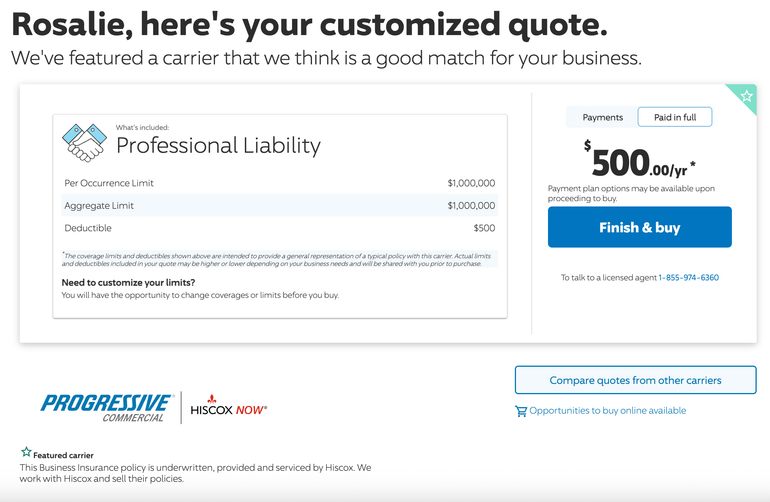
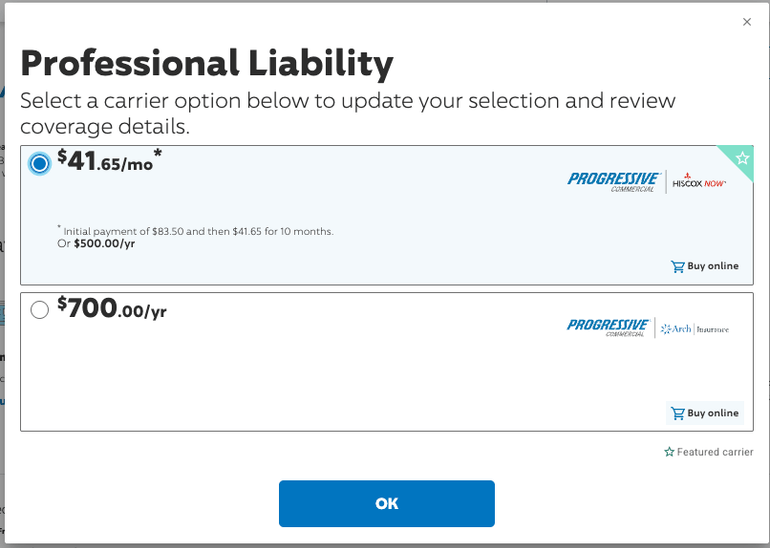
Clicking “compare quotes from other carriers” showed me one additional quote, which was significantly more expensive.
To see what a policy underwritten by Progressive looks like, I started a commercial auto insurance quote.
I told Progressive I work as a florist and my business is a sole proprietorship. I entered my ZIP code, date of birth, address and contact information. I said I travel up to 50 miles one way and visit three clients per day on average. I used the make and model of my last car, a 2013 Toyota Prius, and said it’s fully paid off. I said I drive the car for both personal and business use.
After that, Progressive asked for the details of my personal auto policy. It invited me to add additional insured and waiver of subrogation endorsements. Progressive also invited me to enroll in its Snapshot program, which uses a driver’s phone or a device placed in the car to track their driving. You can get discounts if the insurer thinks you drive more safely than others.
That resulted in my quote.
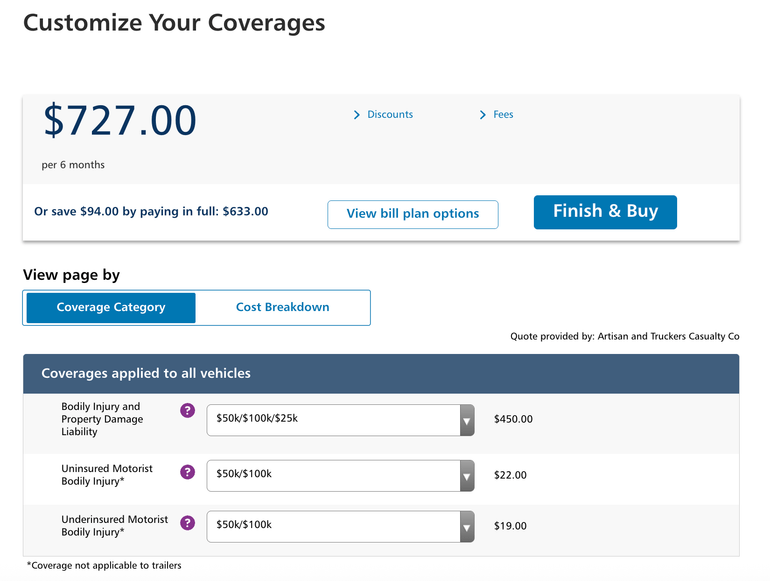
I had the option to adjust limits and deductibles for all the vehicles on my policy. I could also add any auto liability, hired auto liability and employer non-owned auto liability. All those coverages would protect my business finances if I got into an accident driving a different car from the one on my policy.
I found Progressive’s prices confusing. When I clicked “view bill plan options,” I realized that Progressive was only offering a six-month policy. I didn’t have the option to get a policy that would last a year.
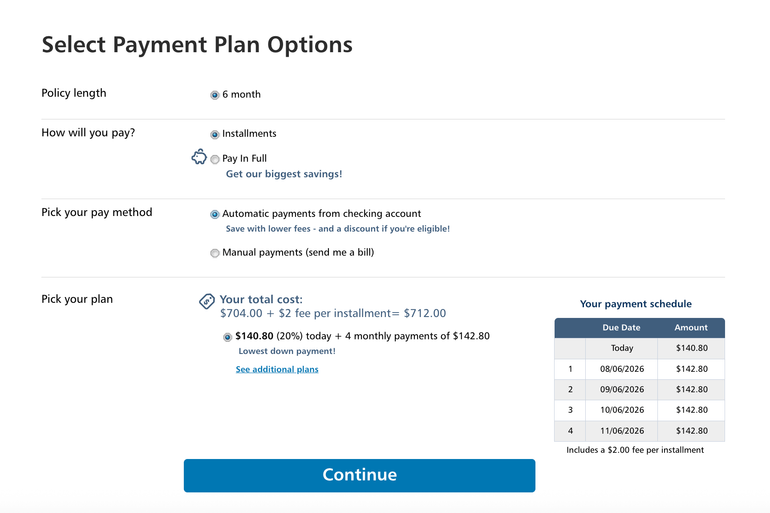
I selected “pay in full.” Progressive sent me back to the page where I could adjust limits and deductibles. Then, I had the option to buy.
The checkout screen asked for my VIN, driver’s license number and EIN. Since I don’t currently own a vehicle, I stopped here.
Each of these quotes could have been clearer about what was happening throughout the process. When I was shopping for liability insurance, it wasn’t obvious that Progressive was sending me to a third-party company for coverage. And when I was shopping for auto insurance, it took me a moment to realize that the policy term was six months, not a year.
Also, Progressive’s quote was slightly more expensive than one I got from Geico on the same day. Plus, that policy lasted 12 months — which would lock in my rate for six more months than a Progressive policy would. But insurers have different levels of appetite for different kinds of vehicles and businesses. Your mileage may vary. That’s why we always recommend getting multiple quotes.
Methodology
Business insurance ratings methodology
NerdWallet rewards business insurance companies for reliability and good service. We calculate star ratings based on scores in about a dozen categories. These include:
Each company's financial strength.
How many complaints customers made relative to its market share.
How easy it is to get coverage.
How accessible customer service is.
Learn more about how we rate small-business insurance companies.
Our editorial team routinely fact-checks and updates these data points. We also adjust our scoring on an ongoing basis. This helps our star ratings reflect changing industry norms. For instance, in 2026, we began evaluating how easy insurers make it to add an additional insured.
Our ratings are a guide. But insurance policy details and prices can vary widely. We encourage you to shop around and compare several insurance quotes. NerdWallet does not receive compensation for any reviews. Read our editorial guidelines.
Insurer complaints methodology
One key factor in our star ratings is how many complaints insurance companies get. Here's how we arrive at that score.
Disappointed customers can file a complaint with their state's insurance department. The National Association of Insurance Commissioners (NAIC) collects, analyzes and groups complaints by business line and insurance company every year. A business line is a specific type of coverage, like workers’ comp.
Then, the NAIC calculates a complaint ratio for each company. It divides the company's share of complaints by its share of total premiums for each line of business. It then adds these ratio values to their official complaint index.
A complaint ratio of 1 means a company received about the expected number of complaints relative to its size.
A ratio of 2 means it received twice as many complaints as expected.
A ratio of 0 means it received half as many complaints as expected.
NerdWallet obtains the raw NAIC data every year. We aggregate results at the company level and fact-check these results. Then we calculate a three-year average of each insurer's complaint ratio and convert it to a score for our star ratings.
Business insurance star ratings consider complaints about two lines of business: commercial liability and commercial property. We analyze complaint data on commercial auto and workers' comp policies too. But we don't currently incorporate these into our ratings since they're less universal.