The minimum credit score required for a business loan typically ranges from 500 to 700, depending on the lender and loan type. Lenders use your personal credit score as a way to assess risk and how likely you are to repay your loan.
In general, the stronger your credit score, the more options you’ll be able to qualify for. Among borrowers approved through NerdWallet Small Business between April 2025 and March 2026, more than 76% reported a credit score of 660 or higher, and nearly a third reported scores of 720 or above.
Below, we’ll break down minimum requirements by loan type and what you can do to build your credit if your score isn’t where you want it to be.
How much do you need?
Minimum credit score requirements by loan type
There is no universal credit score minimum requirement for all business loans. Here’s what you can generally expect based on the loan type:
Loan type | Minimum credit score requirement |
680 to 700+. | |
620 to 680+. | |
600+. | |
570+. | |
550+. | |
500+ (may not require credit check, as underwriting is often based on invoice value and creditworthiness of your customers). | |
500+. |
Business loan options by credit score range
While the table above shows general minimums by loan type, your actual business loan options will depend on where your specific score falls. Here’s a closer look at what each range typically means for your financing search:
700 or above
Credit scores of 700 or more will put just about any business loan option on the table.
750+: Opens up traditional bank loans, bank business lines of credit and SBA loans — plus the lowest available APRs within these already affordable loan types.
700 to 749: Eligible for some of the best business loans out there, like bank loans and SBA loans, but you’ll need stronger business credentials to access the best terms.
Best options: Bank loans, SBA loans, bank lines of credit
640 to 700
Business lenders generally consider this range to be good but not excellent.
On the lower end of this range, you’ll need strong business credentials, like multiple years in business or strong annual revenue, to access bank or SBA options.
If you’re closer to 640 than 699, you’ll likely need to consider alternative options, like community or online lenders.
Best options: Medium-term loans, equipment financing, loans from community lenders.
600 to 640
A sub-640 score means that you're likely ineligible for most bank business loans, and SBA loans will be difficult to qualify for even with excellent business credentials — SBA microloans, which have more flexible requirements, are the exception.
Still, solid options exist for scores above 600.
Strong business credentials: Consider medium-term, online loans or equipment financing.
Newer or lower-volume business: Consider short-term loans and invoice factoring.
Best options: Microloans, equipment financing, medium-term loans, short-term loans, invoice factoring.
550 to 600
This range may make it difficult to qualify for the most affordable alternative lending options. Although you may be able to get a short-term or equipment loan, your rates and terms will be less desirable.
Consider microloans first. These lenders often work with less-qualified businesses and offer competitive rates.
If you need funding quickly, invoice factoring or MCA companies may be an option.
Best options: Microloans, short-term loans, equipment financing, invoice factoring, merchant cash advances.
550 or below
A score in this range is below many lenders' minimum credit requirements. Your options will be fairly limited.
Best options: Invoice factoring (some companies don't consider personal credit), merchant cash advances (though often with high APRs).
🤓 Nerdy Tip
A business loan marketplace, like NerdWallet Small Business, allows you to compare multiple offers at once, without impacting your credit score. Get started with our simple application here.
Why credit scores matter when applying for a business loan
Although there are some loans with no credit check requirements, the vast majority of lenders will consider your personal credit score when deciding whether to work with you — and how they’ll structure your loan if they do.
During the application process, underwriters evaluate risk to the lender — meaning the possibility that you won’t repay your debt. Several factors can signal potential risk: your business is too new or revenue is too low, for example.
Your credit score is one of the clearest signals available, since it’s a historical measurement of your financial responsibility. If you were unable to repay your personal debts on time in the past, it’s a reasonable bet that you’re not going to pay off your business’s debts on time, either.
On the other hand, if your personal financial history is mostly free of faults — like tax liens, bankruptcies and judgments — there’s a good chance you’ll stay on top of your business’s finances, too.
Your credit score doesn't only determine your eligibility for a given business loan, it also shapes the terms that you’re offered, such as loan amount, APR and repayment schedule. A stronger credit history typically translates to higher loan amounts, lower interest rates and longer repayment terms.
Other credentials, like how long you've been in business, your annual revenue and your business credit score, can affect your options too.
About personal credit scores
Your personal credit score is created by two major companies: FICO and VantageScore. Although both companies use a 300 to 850 range, they categorize scores differently:
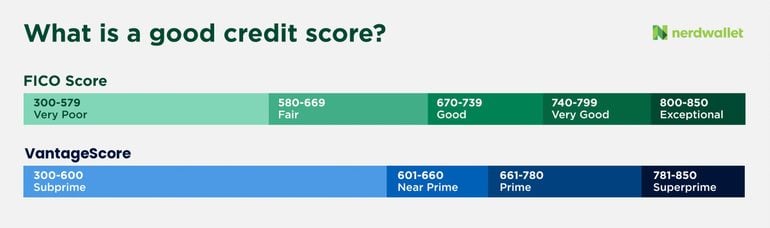
Both companies use information from the three major credit bureaus — Equifax, TransUnion and Experian — to calculate your scores. In general, your score is impacted by:
Payment history.
Amounts owed.
Length of credit history.
New credit.
Credit mix.
You can check your personal credit score for free on NerdWallet or get your credit report from the three major reporting bureaus for free at AnnualCreditReport.com.
About business credit scores
Your business credit score is a measure of your business’s reliability with financial commitments. Commercial credit bureaus (Equifax, Experian, Dun & Bradstreet) determine your score using:
Your payment history to creditors and vendors.
The size and age of your company.
Age of your oldest financial account.
Credit utilization.
Established tradelines.
Risk of failure in your industry.
Prior judgments, like tax liens and bankruptcies.
Not all lenders will consider your business credit score during underwriting, but having a good one can only help your application. You can build your business credit by:
Opening a business bank account.
Using trade credit responsibly.
Keeping public records (like court filings) clean.


How to build your credit before applying
Working toward stronger credit can help you qualify for more financing options, as well as better rates and terms. If your score isn’t where you want it, you might consider:
Making debt repayments more frequently.
Looking for errors on your credit reports (e.g., payments marked late when you paid on time, someone else's credit activity mixed with yours) and disputing them with the appropriate credit bureau.
Getting added as an authorized user on a credit card of someone you know and trust who has a strong credit score.
Avoiding new hard inquiries in the months before applying for a loan.
Frequently asked questions
What credit score is needed for a business loan?
At a minimum, you’ll need a credit score of 500 to qualify with certain alternative lenders. To access the most competitive options, you’ll usually want a score of 700 or higher.
What is a good credit score for a business loan?
A good FICO score is a score of 670 to 739. In general, a score of 670 or higher will help you qualify for a variety of loan options — especially if you have other strong credentials.
What’s required for a business loan if you have a poor credit score?
If you have a lower credit score, it’s useful to have strong business finances and several years in operation. You can also offer collateral or get a cosigner to help you qualify.


Article sources
- 1.NerdWallet. 2026 NerdWallet Business Loan Study. Accessed Aug 4, 2026.