Calculated payments and savings are estimates. The calculator result does not constitute an offer for a loan and will not solicit a loan offer. Savings will depend on the actual amounts and rate for which you are approved, should you choose to apply.
Getting a Mortgage in Vermont
Written by
, Edited by
and
Last updated November 19, 2025
Real estate markets can vary dramatically by location, which is why national housing averages don’t always reflect what buyers actually pay. Housing costs are just one part of affordability, and tools like a cost of living calculator can help show how factors such as taxes, utilities, and everyday expenses differ from place to place.
Mortgage costs in Vermont, the Green Mountain State, vary depending on where you buy. In Chittenden County, home to Burlington and some of the state’s most expensive housing markets, the typical monthly mortgage payment for a median-priced home was $2,893 in Q1 2025, based on a median home value of $$493,589, according to the National Association of Realtors. By comparison, the national median monthly payment was $2,120 for a median-priced single-family home valued at $402,300.
By contrast, Rutland County is more affordable. There, the typical monthly mortgage payment was $1,439 for a median-priced home valued at $245,470, reflecting lower demand and more moderate home prices outside Vermont’s highest-cost regions.
Taking U.S. Census data, NerdWallet has crunched the numbers to help you understand what property tax rate you can expect to pay on your future home in Vermont. Because assessed values aren't frequently updated, you may pay a higher rate at first but eventually you'll pay a similar rate.
County
Avg. property tax rate
Median home value
Addison County
1.56%
$311,200
Bennington County
1.56%
$243,000
Caledonia County
1.71%
$197,700
Chittenden County
1.59%
$422,800
Essex County
1.60%
$151,200
Franklin County
1.51%
$263,200
Grand Isle County
1.40%
$339,600
Lamoille County
1.51%
$270,700
Orange County
1.76%
$231,000
Orleans County
1.54%
$196,700
Rutland County
1.74%
$203,500
Washington County
1.81%
$278,000
Windham County
1.84%
$250,000
Windsor County
1.79%
$249,700
Source: American Communities Survey 2022, U.S. Census
How to use the mortgage calculator
To use our mortgage calculator, add your details to the following fields:
Home price
Down payment
Interest rate
Loan term (years)
After you enter this information, the calculator displays the monthly payment, as well as:
Total principal
Total interest payments
Payoff date
Calculating costs in addition to principal and interest
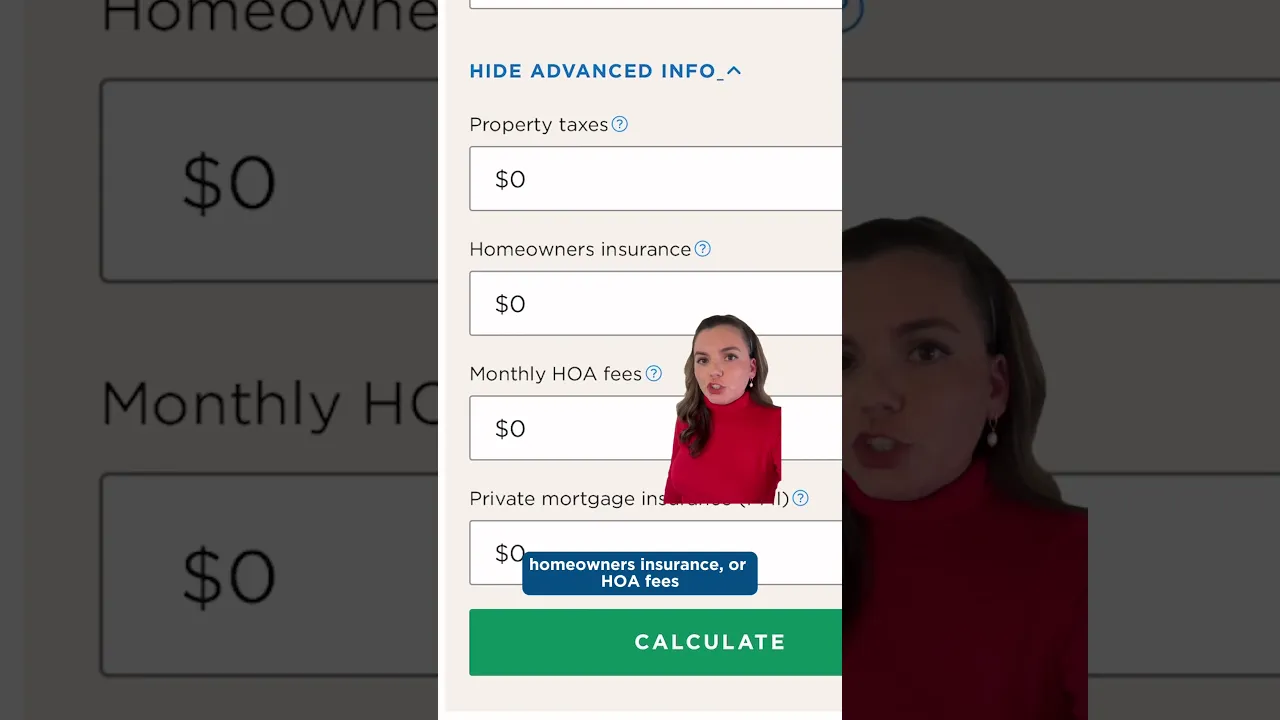
The calculator lets you fine-tune your payment by entering your annual property tax premium, annual home insurance premium, monthly homeowner association (HOA) fee, and monthly private mortgage insurance (PMI) premium.
To enter this information, click “Show Advanced Info” underneath the main loan details. Note that you'll enter the annual cost for property taxes and home insurance and the monthly cost for HOA fees and PMI premiums. The PMI field will only display if your down payment is less than 20%.
In the “Loan Estimate” window, select "Amortization Schedule" to uncover a table that shows how much you'll pay in principal and interest each month, as well as the remaining amount you owe ("Principal balance") after making the payment.
Total monthly payment: An estimate of all your monthly housing costs, covering your loan principal, interest, taxes, insurance, and PMI.
Total principal: This is the amount you borrow. Each mortgage payment reduces the principal you owe.
Total interest payments: How much interest you would pay over the life of the loan.
Total loan payments: The entire amount of principal and interest paid, excluding taxes, insurance, and PMI.
Down payment: The portion of the home’s price you pay in cash upfront.
Interest rate: How much the lender charges you to lend you the money. Interest rates are expressed as an annual percentage. A lower interest rate gives you a smaller monthly payment.
Loan term (years): The number of years you have to repay the mortgage. A longer term gives you a lower monthly payment, but you’ll pay more interest.
Start date: The month that your first mortgage payment is due.
Payoff date: The month your home will be fully paid off based on the loan term.
Property taxes: The annual tax assessed by a government authority on your home and land. You pay about one-twelfth of your annual property tax bill with each mortgage payment, and the servicer saves them in an escrow account. When the taxes are due, the loan servicer pays them.
Homeowners insurance: Your policy covers damage and financial losses from fire, storms, theft, a tree falling on your house and other bad things. As with property taxes, you pay roughly one-twelfth of your annual homeowners insurance premium each month, and the servicer pays the bill when it's due.
Monthly HOA fees: The amount you may pay each month if you belong to a homeowners association. Typically, these dues are billed directly, not added to the monthly mortgage payment. Because HOA dues can be easy to forget when considering the cost of homeownership, NerdWallet's mortgage calculator allows you to enter them here.
Private mortgage insurance: If you get a conventional mortgage and put down less than 20%, you’ll have to pay a monthly PMI premium. It covers the lender if you default on the loan and can be canceled once you reach 20% equity. FHA loans require a similar fee called a mortgage insurance premium.