








The Capital One Venture Business and Chase Ink Business Preferred are two of the best entry-level business travel cards. Picking between the two really comes down to two things: where your business spends and how much you value simplicity.
The Capital One Venture Business is the set-it-and-forget-it option. You get 2x miles on all purchases with no bonus categories to navigate. You can easily turn the points you earn into a statement credit for travel-related purchases or to book travel via CapOne's portal. (This card was previously the Spark Miles for Business. Capital One rebranded it in April 2026.)
The Ink Business Preferred® Credit Card wins if you want maximum rewards. That's especially true if you spend a lot on ads, travel, shipping or telecom. You'll get 3x points on the first $150,000 spent in those categories combined each year. Don't spend in those areas? The card loses its luster.
How the cards compare

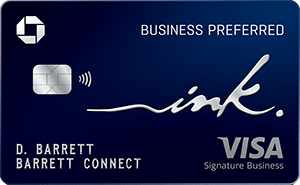
Annual fee
$95
$95
Bonus offer
100,000
miles
100,000
points
Rewards
2x-5x
miles
1x-5x
points
Interest rate
24.49% Variable APR
17.74%-26.74% Variable APR
Still not sure?
Capital One Venture Business vs. Chase Ink Business Preferred: deciding factors
Ongoing rewards
🏆 Winner: Depends on spend
If the bulk of your business spend is on advertising, travel, shipping or phone/internet services, the Ink Business Preferred® Credit Card is the clear winner. You'll earn 3 points for every $1 spent in those categories (up to $150,000 annually).
Here's what that looks like if you max out your bonus categories:
Points/miles earned | Dollar value (1 point/mile = 1 cent) | |
|---|---|---|
Ink Business Preferred® Credit Card | 450,000 | $4,500 |
Capital One Venture Business | 300,000 | $3,000 |
But if your spending falls outside of those categories, you'll earn twice as many points with the Capital One Venture Business.
Points/miles earned | Dollar value (1 point/mile = 1 cent) | |
|---|---|---|
Ink Business Preferred® Credit Card | 150,000 | $1,500 |
Capital One Venture Business | 300,000 | $3,000 |
The newly minted Capital One Venture Business also has two annual credits:
- $50 for travel bookings with Capital One Business Travel.
- $50 statement credit for qualifying advertising and software purchases.
Sign-up bonus
🏆 Winner: Chase Ink Business Preferred
The welcome bonuses match at 100,000 points/miles, but the Ink Preferred's lower spending requirement — $8,000 vs. $10,000 in three months — earns it the win.
Travel protections and perks
🏆 Winner: Chase Ink Business Preferred
The Capital One Venture Business will give you a credit of up to $120 for Global Entry or TSA PreCheck® application fees paid with the card. But that's the only advantage it carries in this area.
Travel Perk or Protection | Capital One Venture Business | Ink Business Preferred® Credit Card |
|---|---|---|
Trip cancellation/interruption | No | Yes |
Trip delay reimbursement | No | Yes |
Rental car insurance | No | Yes |
Baggage delay or loss | No | Yes |
Travel accident insurance | Yes | Yes |
Purchase protection | Yes | Yes |
Extended warranty | No | Yes |
Cell phone protection | No | Yes |
TSA PreCheck®/Global Entry reimbursement | Yes | No |