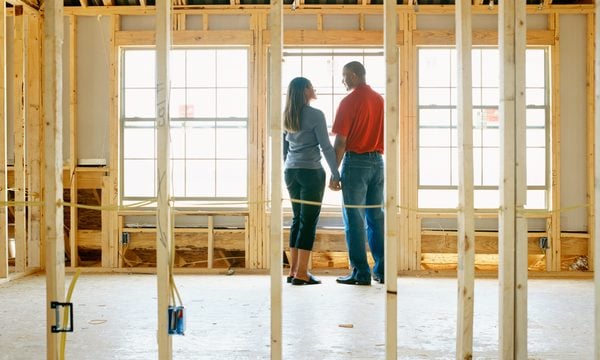





If you’re house-hunting in a hot market, you may have wondered: “Why don’t I just build?”
Choosing a modular home can save you money and time, compared to traditional construction methods for a single-family home. Modular homes can be more environmentally friendly, too.
Just like a traditional build though, be prepared to manage a lot of details and decisions along the way. You still have to research contractors and buy a suitable lot. And if you can’t pay cash, you’ll likely need a construction loan, which can be harder to get than a typical mortgage.
But let’s be honest: You’re probably up for the extra work, or else you wouldn’t be feeling the itch to build.
What is a modular home?
Modular homes are one of many types of prefabricated, or “prefab,” homes. This means that some (or all) of the home was built in a factory. As the name suggests, a modular home is made up of large, three-dimensional pieces known as modules. These are built indoors, then shipped to your building site.
That’s different from traditional construction, also called “site-built” or “stick-built.” In this method, your home is fully constructed at the building site.
Prefab homes get a bad rap for being flimsy or cheap. However, with most modular homes, that’s not the case. Modular homes follow state and local building codes and are affixed to a permanent foundation, just like site-built homes.
You might be surprised to know that modular homes can be customizable, too. Your builder will offer a range of floor plans and designs to choose from, and you can personalize from there.


Manufactured vs. modular homes
Modular and manufactured homes are both pre-built in factories, but they have some key differences.
Manufactured homes are factory-built homes constructed to the federal HUD Code, which establishes national standards for design, construction, durability, energy efficiency and safety. They are built in a controlled factory environment and transported to their home site, offering an affordable and efficient housing option.
Modular homes are also factory-built but are constructed to the same state and local building codes as site-built homes. They are built in sections, transported to the building site, assembled on a permanent foundation and inspected to ensure compliance with local building requirements.
How is a modular home built?
When the completed modules leave the factory, they have up to 90% of what you’d need in a finished home. That includes:
Floor, walls and ceiling
Plumbing, electrical and HVAC
Siding and shutters
Light fixtures and cabinets
The completed modules are shipped to your building site, where they’re attached to the permanent foundation and each other. Then, the finished home is inspected to make sure it meets (or exceeds) local codes.
Modular homes vs. site-built homes
Whether you choose a modular or a site-built home, you’re still responsible for many of the same decisions.
First, that means finding and buying land. This is typically a separate cost from the price of your home, so budget accordingly.
Once you have land, you’ll still need to secure inspections, permits and utility hookups. Some (but not all) modular builders will roll these into the cost of your home. If not, prepare to pay for them out of pocket — and to handle all the logistics.
Most importantly: Do your research before you pick a builder. Visit home shows or open houses, ask questions and get references.
Whether you decide on modular or site-built construction, it matters most to work with a reputable builder you can trust.
Advantages of modular homes
Affordable: Factory construction drives down the cost of materials and labor, compared to site-built homes.
Faster move-in: Indoor construction eliminates most weather delays. And while the modules are being built indoors, a crew can simultaneously prep the building site and pour the foundation. According to the National Association of Home Builders, some modular homes can be move-in ready in as little as three months which is significantly faster than the average timeline for site-built homes, based on 2024 Census Bureau data.
Durable: After Hurricane Andrew, the Federal Emergency Management Agency found that module-to-module construction held up better than other home types.
Less construction waste: Less waste at the building site means you’ll save on waste disposal costs, too. According to the Modular Home Builders Association, modular builds can generate about half as much waste as site-built homes.
Energy efficiency: Super-tight seals and seams keep drafts out — and your heating and cooling bills low.
Disadvantages of modular homes
Transportation cost: Rising gas prices can impact transportation costs. So can supply chain issues, such as availability of specialized equipment and skilled drivers. Extra large modules that meet criteria for an “oversized load” might cost more to transport, too.
Logistics: Some states require an escort or pilot vehicle to accompany oversized loads in transit. It’s not easy to drive a giant trailer under low overpasses and power lines. Tight turns, narrow bridges, steep hills or muddy roads can all make transportation more difficult, too.
Construction loans for modular homes
Once construction is complete on a modular home, it can be financed with a traditional mortgage just like an existing home.
While it's being built, builders often require upfront or installment payments. If you can pay cash, you’ll avoid interest and extra paperwork. Otherwise, a construction loan might be your best option, much like if you chose a site-built home.
A construction loan is a short-term loan that provides cash flow while your modular home is being built. When construction is complete, you can convert or refinance the loan into a standard mortgage.
However, it can be more difficult to qualify for a construction loan compared to a regular mortgage because you don’t yet have a completed house to serve as collateral. Expect your lender to do an in-depth check of your builder and architectural plans, as well as your finances.
It pays to shop around for a construction loan, just as you would for a traditional mortgage. You’ll qualify for the best rates if you have a high credit score and low debt-to-income ratio.
NerdWallet writer Isabella Angelos contributed to this story.