Airbnb’s business is booming. The popular platform reported its highest revenue and profit ever in the third quarter of 2022, due in large part to strong demand and higher daily rates. The surging vacation rental industry has caught the attention of real estate investors and entrepreneurs, who have been amassing large portfolios of short-term rental properties to cash in on the boom.
“Over the last three years in the world of real estate investing, short-term rentals have been sort of a gold rush,” says Tony J. Robinson, co-host of The Real Estate Rookie podcast. Similar to the actual gold rushes in the 19th century, he says, many investors were drawn to short-term rental investment without the appropriate tools or skills.
“I think a lot of people who jumped in looking to make a quick buck will back out.”
According to an article in Bloomberg Markets, many of these pop-up Airbnb empires were funded with risky loans backed not by large down payments or borrower salaries, but by the potential future earnings of the rentals themselves. If the short-term rental boom were to bust, it could spell serious trouble for these investors and the banks that funded them.
Few experts predict a full-on housing crash like the one we saw from 2008-2014, in part because lending standards are much higher for residential mortgages now than they were in the years leading up to 2008. Yet the loans supporting these vacation rentals entrepreneurs could rest on shakier ground.
Rather than being inundated by foreclosures from underwater homeowners, the property market — particularly in tourism-dependent areas — could get oversupplied by the very investors who were snapping up houses throughout the pandemic: Airbnb landlords.
“At a national level, a wholesale dumping of Airbnb houses would be needed to create a crash,” said Jaime Peters, assistant dean of accounting, economics and finance at Maryville University’s John E. Simon School of Business in an email interview.
Demand far outstrips supply in the current housing market, where many home buyers have shopped for months, and made multiple offers, without succeeding in a purchase. “There are less than 800,000 homes on the market nationwide," according to the St. Louis Federal Reserve, adds Peters. “That level of inventory is still really low.”
If Airbnb investors sold their properties and freed up supply, in other words, it could offer some relief for harried homebuyers.
A supply glut
Airbnb hosts keep adding new listings at a breakneck pace. Total short-term rental supply in the U.S. reached 1.38 million listings in September, up 23% compared with the same time last year, according to AirDNA, an industry analytics firm. A whopping 62% of active listings have been added since 2020.
Geographically, these new listings are not evenly distributed. The Phoenix and Scottsdale market saw a 44% increase year over year, while Las Vegas saw a 36% increase in new listings. Meanwhile, these Sun Belt cities are now experiencing some of the fastest-dropping housing prices in the country, down 4.4% and 4.8%, respectively, from their peaks in the spring, according to AEI Housing Center.
The number of short-term rental listings in small-town and rural areas nearly doubled between May 2019 and May 2022, according to a joint report by AirDNA and STR, another analytics firm. This follows a trend of U.S. travelers seeking fresh air and solitude during the pandemic, but could prove disastrous for Airbnb landlords in these areas if travel patterns return to normal.
“Rural areas are in danger,” says Peters. “The lack of alternative uses of grand rental mansions, with hot tubs, game rooms and sweeping vistas in rural areas make them particularly vulnerable. A small apartment in New York City can always be converted back into the (typically less profitable) long-term rental, but that is difficult with a seven-bedroom mansion in rural Georgia.”
Robinson, who manages 30 properties across the country, shares similar concerns about a potential slowdown in demand for rural vacation rentals.
“If I try to convert my Tennessee properties into long-term rentals, I wouldn’t make money,” he says. “So I would be motivated to sell.”
Softening demand, increasing scrutiny
Hosts themselves have already begun ringing the alarm about an “Airbnbust,” based on a viral tweet from a host in October.
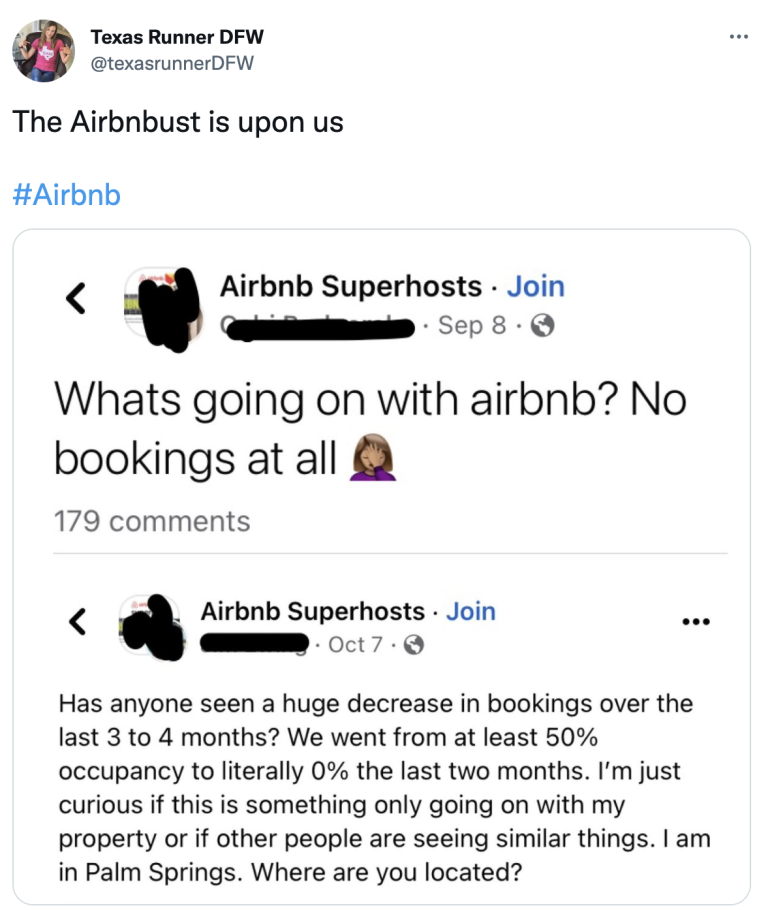
This has coincided with a backlash against Airbnb among guests and media pundits, who have complained about high prices, confusing fees and disappointing rentals. The CEO of Airbnb, Brian Chesky, recently addressed these concerns on Twitter, saying “I’ve heard you loud and clear,” and promising to improve these experiences for guests.
Yet whether because of disgruntled guests, inflation or changes in travel patterns, demand for vacation rentals does seem to be softening. In its third-quarter financial results, Airbnb lowered its forecasts for Q4 revenue. And data from AirDNA indicates that occupancy (the share of available nights that are booked) has dropped 1.2% year over year, suggesting that supply is indeed outpacing demand.
And the short-term rental industry faces other headwinds that could cause many Airbnb landlords to dump their portfolios, beyond simple supply and demand.
The New Orleans City Council recently passed a temporary ban on new short-term rentals in October. And the city of Palm Springs, California, a popular vacation rental destination, placed a cap on the number of these rentals allowed per neighborhood.
“In areas where tourism is the main attraction, there are two dangers,” says Peters. “The growing popularity and supply of Airbnbs means more competition and, thus, lower prices. Second, when demand slows down — such as a recession — leveraged, amateur owners are likely to be the first to need to sell.”
How to maximize your rewards
You want a travel credit card that prioritizes what’s important to you. Here are some of the best travel credit cards of 2026:
- Flexibility, point transfers and a large bonus: Chase Sapphire Preferred® Card
- No annual fee: Wells Fargo Autograph® Card
- Flat-rate travel rewards: Capital One Venture Rewards Credit Card
- Bonus travel rewards and high-end perks: Chase Sapphire Reserve®
- Luxury perks: American Express Platinum Card®
- Business travelers: Ink Business Preferred® Credit Card
Explore more on