Many times in the world of air travel you might hear the words “layover,” “stopover” and “open-jaw” flight but not be quite sure what they mean.
The main difference between a stopover and layover is length of time. Stopover rules vary by airline, but are essentially longer layovers — at least 24 hours in length. Layovers, meanwhile, are connections less than a day in length depending on if you’re flying domestically or internationally.
Open-jaw flights are a whole different beast. Follow this quick guide and we’ll help you arrive at an understanding of stopover, layover and open-jaw flights.
What is a layover?
A layover is the technical term for what you might think of as a simple connecting flight. For example, earlier this year, I flew from Cincinnati to Boston on American Airlines. Because there are no direct flights between Cincinnati and Boston on American, I had to make a connection. There were several options for my connection, mostly in American hub airports like New York LaGuardia, Washington National or Philadelphia. I chose one in Washington (DCA).
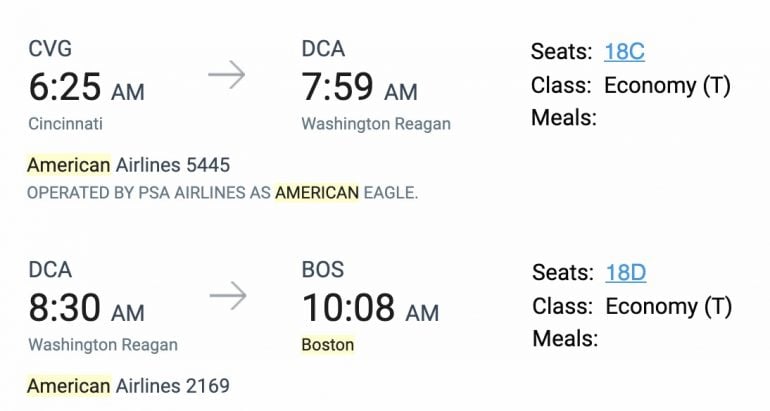
In this case, I had only a 31-minute layover, which made me a bit nervous. Layovers this short are great when everything goes right, since you walk right off of one flight and on to the next, but they don’t have a lot of room for error. Thankfully, my first flight arrived about 15 minutes early, so I had plenty of time to make it to my next flight.
Another note about layovers: While they usually involve changing gates and planes, that is not always the case. Southwest, for example, will often have layovers that involve no plane change.
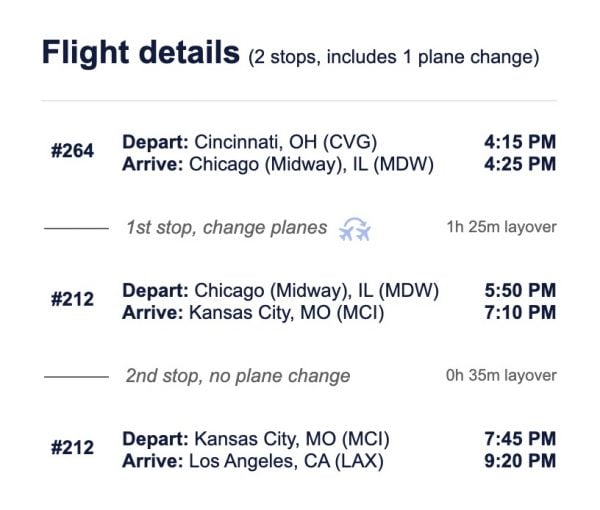
In a case like this, you would arrive in Kansas City and wait for all the departing passengers to deplane. Then you would await the passengers going from Kansas City to Los Angeles.
Stopover meaning in airlines
At its simplest, a stopover is simply a longer layover. Most airlines define a layover as any connection of less than 4 hours on a domestic flight or less than 24 hours on an international flight. Rules about when stopovers are allowed varies by airline, and it will often depend on whether the ticket is an award ticket or a paid ticket.
Here are two examples of stopovers I have personally taken:
Using rewards from Alaska Airlines to fly Emirates, I booked a ticket from Singapore to Dubai (2-day stopover) to New York City.
On a paid ticket, I flew Newark to Lisbon (3-day stopover) before continuing on to Barcelona.
Most airlines that offered free stopovers on award tickets have eliminated that perk. There are a few (but dwindling) number of airlines that offer stopovers on award tickets:
Singapore Airlines offers two complimentary stopovers on a round-trip ticket using KrisFlyer miles.
Alaska Airlines even offers a free stopover on ONE-WAY award tickets (see my Dubai example above).
United Airlines doesn’t allow stopovers per se, but it does have a similar program called the Excursionist Perk.
Even if the airline whose miles you are using does not allow stopovers on award flights, you can still get a lot of value from including a layover of up to 23 hours 59 minutes. As an example, on the same Singapore trip I mentioned earlier, I used American Airlines AAdvantage miles to book the outbound portion of the trip, which included a 20-hour layover in Hong Kong at no additional charge.
While that wasn’t enough time to see much of Hong Kong, it was at least enough to take a brief city tour, have some street food and get a taste of the city before returning to the airport and boarding the connecting flight to Singapore.
» Learn more: The best airlines for free stopovers

By signing up, you will receive newsletters and promotional content and agree to our Terms of Use and acknowledge the data practices in our Privacy Policy. You may unsubscribe at any time.
Open-jaw flights: How they work
An open-jaw flight is two or more flights in an itinerary with an “open” segment in the middle. The open “V” shape formed by the outbound and return lines of travel is similar to the profile of an open mouth or jaw. A simple example would be a round-trip itinerary as follows:
New York to Paris.
Frankfurt to New York.
You start and end your itinerary in New York, but your European itinerary has an open-jaw between Paris and Frankfurt. This itinerary does not cover your travel between those two European cities. Of course you will have to physically get yourself from Paris to Frankfurt, but you are on your own for that transportation. It could be by car, train, a separately booked flight or any other mode of travel.
Open-jaw itineraries don’t have to start and end in the same location and aren’t limited to only 2 flights. Here is another example of an open-jaw itinerary:
Chicago to London.
London to Stockholm.
Copenhagen to Los Angeles.
In this itinerary you have an open-jaw between your origin and return (Chicago to Los Angeles) as well as an open-jaw on your destination (Stockholm to Copenhagen). In both of those cases you would need to arrange your own transportation between the two cities. You also have a connection (either a layover or stopover) in London.
How to maximize your rewards
You want a travel credit card that prioritizes what’s important to you. Here are some of the best travel credit cards of 2026:
Flexibility, point transfers and a large bonus: Chase Sapphire Preferred® Card
No annual fee: Wells Fargo Autograph® Card
Flat-rate travel rewards: Capital One Venture Rewards Credit Card
Bonus travel rewards and high-end perks: Chase Sapphire Reserve®
Luxury perks: American Express Platinum Card®
Business travelers: Ink Business Preferred® Credit Card