











Refinancing a car loan means you’re replacing your current loan with a new one. The new loan usually has a lower interest rate or different repayment period, which can save you money or make your payment more manageable. Applying to refinance a car loan often takes less than an hour, and many lenders let you know immediately if you’re approved.
You might want to refinance your car loan for different reasons. If your credit has improved since you took out the original loan, or a dealership stuck you with a too-high interest rate, refinancing may get you a lower rate.
Refinancing doesn’t always save you money. If you’re struggling to make monthly car payments, refinancing is a way you can decrease your payments. Oftentimes, lowering your monthly payments means you're opting for a longer loan term. Extending the length of the loan won’t save you money, but it could be a good option for you if it means you'll stay on top of your payment.
Here’s a quick guide to refinancing a car loan, including what to know, how to compare rates and how to apply for loans without taking multiple hits to your credit score.
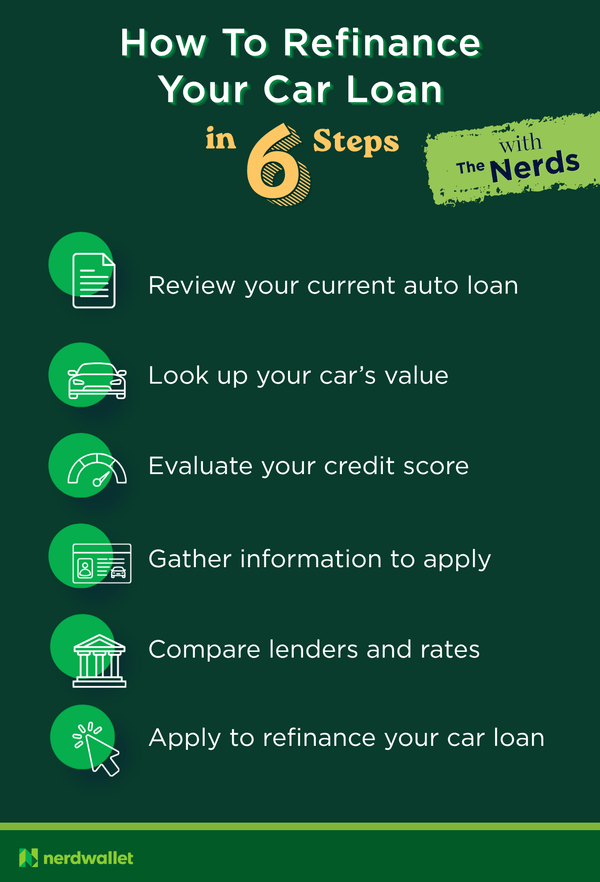
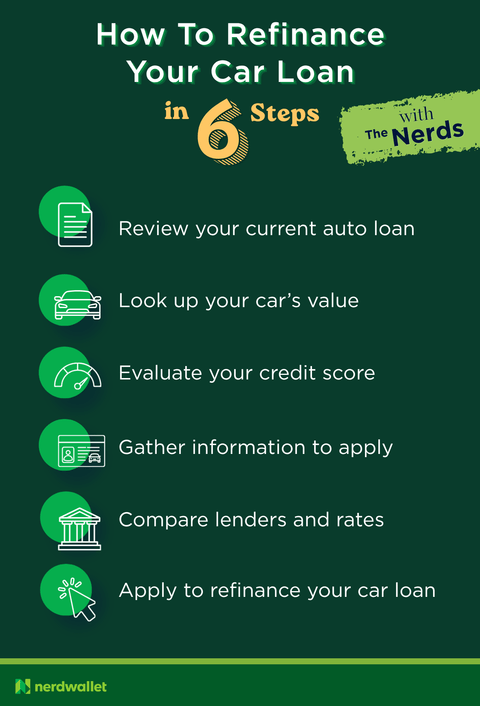
1. Review your existing auto loan
Look up the following information:
Amount of your current monthly payment.
Interest rate (also known as APR) for your current loan.
Number of months left to repay your current loan.
Amount to pay off your existing loan. (A payoff amount is not always the same as the remaining loan balance.)
You can often find this information online through your lender’s portal or on your loan statement if you get one through the mail.
If you can’t find it online or in a statement, your contract should list your monthly payment amount and APR. You can call your lender’s customer service department for the remaining months on the loan and payoff amount.
2. Look up the value of your car
With car prices rising to record highs in the past several years, it’s important to know the current value of your car. Vehicles depreciate quickly in value, and some car owners find themselves with a vehicle worth less than the loan balance they still owe. This is called having negative equity or being upside-down on your car loan.
Refinancing a car loan with negative equity can be difficult, especially if you don’t have good credit. If you owe more than your car is worth, you probably can’t refinance until you gain some positive equity. You can gain positive equity by making on-time car payments and paying extra — even if it’s a small amount — each month. Just make sure your lender is applying any extra to your loan’s principal, not to interest.
To estimate what your car is worth, you can use resources like Kelley Blue Book and Edmunds.com. Also, online car retailers like CarMax and Carvana provide cash offers that you can use as a baseline.
3. Evaluate your credit
Knowing your credit score can help you gauge if you’ll qualify for a loan and the range of interest rates you might expect. This information can help you decide whether it makes sense to refinance your car loan right now.
You can pull your own credit report — that’s a history of your credit activity — or check your credit score for free to see where you stand. You might even get a free credit score through your credit card. Checking your own credit won’t lower your score.
If you’ve made all your car loan payments on time for six to 12 months and kept other credit accounts in good standing, your credit may have improved. If so, there’s a chance you can refinance your car loan with a lower interest rate.
Keep in mind that lenders look at other factors beyond credit scores when approving loans. So even if you have a low credit score, you’re likely to find a lender willing to approve refinancing, but the new loan may not improve on your current one.
4. Get information together for your application
The information you need to apply to refinance a car loan varies by lender and where you are in the application process. Most lenders will request the following information at some point, so you can prepare by gathering everything ahead of time. Here’s what you’ll need:
Your driver’s license.
Vehicle registration.
Proof of insurance.
The vehicle identification number, or VIN, of your car.
Pay stubs from your current employer or proof of employment.
Your Social Security number.
A statement of loan payoff amount from your current lender.
5. Compare lenders and rates
Use prequalification to your advantage. Prequalification lets you see what loan terms you might qualify for without going through the full application process. You provide information, such as your income, and lenders often do a soft credit check, which doesn’t affect your credit score.
You’ll receive prequalified loan offers with rate and payment estimates, so you get an idea whether refinancing to a new loan will be an improvement.
Test scenarios with an auto refinance calculator. NerdWallet’s auto loan refinance calculator can help you compare prequalified loan offers to your existing loan. You’ll enter information about your current loan, such as the original loan amount, interest rate and the length of the loan in months, and then information about your potential refinance loan.
This will show you the amount you could potentially save on your monthly car payment and help you narrow down where you want to apply.
Pay attention to auto loan terms when you compare loans. Some loan offers may be for a longer term than you currently have.
Often, lenders suggest a longer term to lower your monthly payment. If your budget is stretched, a longer term can give you a little financial breathing room, but it also means you will pay more interest in the long run. Still, that's better than missing payments and damaging your credit history.
Shortening the length of the loan is also an option. If your financial situation has improved, you could refinance to a shorter term, keep your monthly payment about the same and pay off the loan sooner. This saves you money because you’ll pay less interest over the life of the loan.
6. Apply to refinance your car loan
Prequalification provides estimated offers and is not loan approval, so your last step is to get final loan approval from one or more lenders. Depending on what information the lender requested when you prequalified, you may need to provide more information for approval.
If you want to apply for loans with more than one lender to compare firm loan offers, do so within a 14-day period. Similar credit score queries in this time period are typically grouped together and treated as one, which lessens the impact on your credit score.
Once you choose a lender and let it know you want to finalize the loan, you’ll receive new loan documents to sign. The lender will start a new loan with the new rate and term length you agreed on.
Your new lender will either pay off your old loan or provide the funds for you to do so. If your new lender says it will pay off the old loan, it’s still a good idea to follow up and make sure it did.
Your final step? Watch for information from your new lender about when and how to start making payments on your auto refinance loan.
How much refinancing can save you on a car loan
Whether you can save money by refinancing and how much will depend on your specific situation, but here’s an example.
Say you start with a $30,000 auto loan with a 9% interest rate and 60-month term. After a year of making monthly payments of $622.75, you’d still owe $25,025 on your loan (not including interest).
If you refinance the remaining $25,025 for 48 months at a lower rate of 7%, you’ll lower the monthly payment to $599.25.
That saves you $23.50 each month, which saves you almost $1,100 over the next four years.