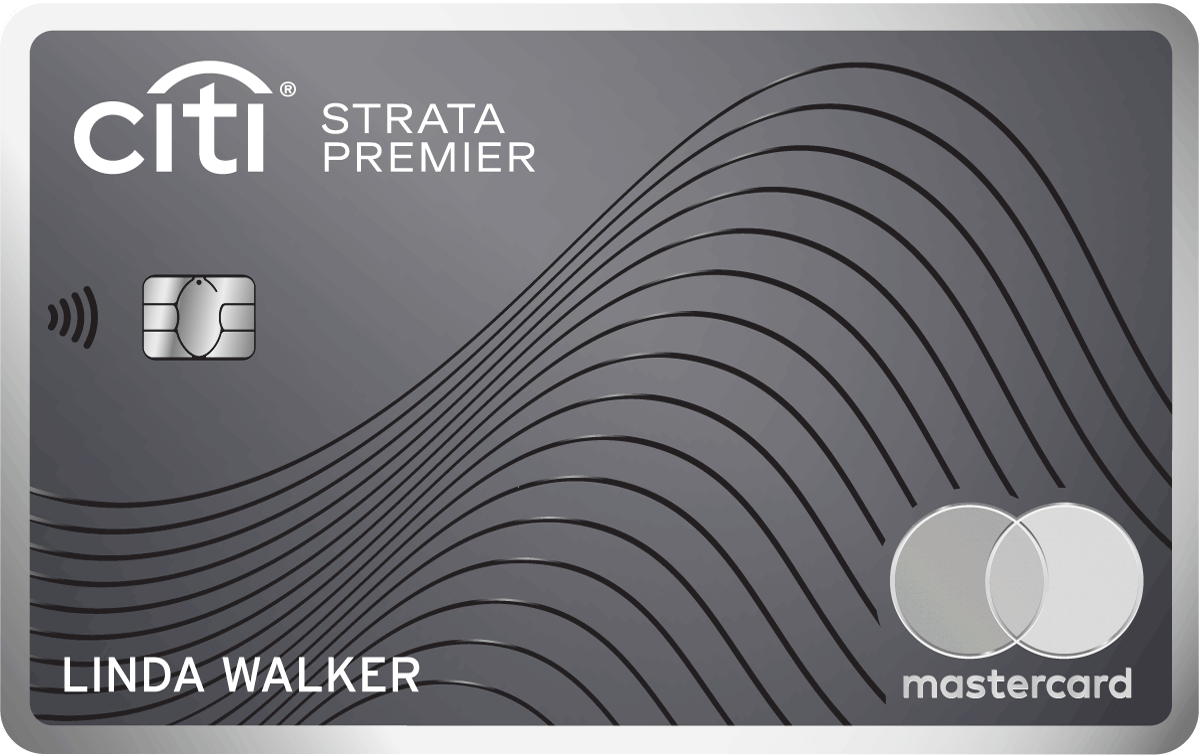
The Chase Sapphire Preferred® Card and the Citi Strata Premier® Card have a lot of similarities. Both charge a moderate $95 annual fee — not exactly cheap, but still a ways off from premium card prices, which range up to $695 or higher. Both feature generous bonus offers and earn elevated rewards on popular purchases like travel and dining.
In other words, these two cards are closely matched.
If you’re stuck on trying to decide which of these two travel credit cards to get, here’s a look at how they stack up and what you should consider.
How the cards compare

Annual fee
Sign-up bonus
Ongoing rewards
- 5 Chase Ultimate Rewards® points per $1 on all travel purchased through Chase.
- 3 points per $1 on dining (including eligible delivery services and takeout).
- 3 points per $1 on select streaming services.
- 3 points per $1 on online grocery purchases (not including Target, Walmart and wholesale clubs).
- 3 points per $1 on gas and EV charging.
- 3 points per $1 on vacation rentals booked directly with brands like AirBnB and VRBO.
- 2 points per $1 on travel not purchased through Chase.
- 1 point per $1 on other travel purchases.
- Through Sept. 30, 2027: 5 points per $1 spent on Lyft.
- Through Dec. 31, 2027: 5 points per $1 spent on eligible Peloton purchases over $150.
- 10 Citi ThankYou® points per $1 on hotels, car rentals and attractions booked through Citi.
- 3 points per $1 at restaurants.
- 3 points per $1 at supermarkets.
- 3 points per $1 at gas stations and EV charging stations.
- 3 points per $1 at other hotels.
- 3 points per $1 on air travel.
APR
Still not sure?
Where the Citi Strata Premier® Card shines
Rich ongoing rewards for travel
For many popular everyday spending categories, the Citi Strata Premier® Card is a points-earning powerhouse. You'll snag triple points at restaurants, supermarkets and gas stations, which are the biggest line items in many household budgets.
And beyond that, you can earn triple points when you book directly with hotels and airlines, and an eye-popping 10x points if you're willing to book some eligible travel through Citi instead.
The Chase Sapphire Preferred® Card only earns 5 points per $1 on all travel purchased through Chase and 2 points per $1 on travel not purchased through Chase. However, when it comes to actually redeeming your points, the Chase Sapphire Preferred® Card has the edge. More on that later.
Where the Chase Sapphire Preferred® Card shines
Points are potentially worth more for travel
The Ultimate Rewards® points you earn with the Chase Sapphire Preferred® Card can potentially take on a higher value when you redeem them through Chase's travel portal. Here’s how it works:
Through Chase’s Points Boost redemption program that was introduced in June 2025, if you applied for the Chase Sapphire Preferred® Card on or after June 23, 2025, your points can be worth up to 1.5 cents each on select airline and hotel bookings and up to 1.75 cents each for premium cabin tickets. Points Boost applies only to eligible bookings made through Chase's travel portal, and points are worth 1 cent each when redeemed for travel not eligible for Points Boost.
Note that if you applied for a Chase Sapphire Preferred® Card before June 23, 2025, points earned before Oct. 26, 2025, can be redeemed for travel through Chase at a value of at least 1.25 cents each, until Oct. 26, 2027. And those points will also be eligible for Points Boost offers — which means they can be worth up to 1.75 cents each.
Comparatively, points earned with the Citi Strata Premier® Card are generally worth 1 cent each when redeemed through Citi's travel portal. There's no "points boost" possibility.
More popular domestic transfer options
Both the Citi Strata Premier® Card and the Chase Sapphire Preferred® Card offer the option to transfer your points to a handful of travel partners at a 1:1 ratio. If you’re willing to put in a little more work to find award availability, transferring your points to one of those airlines or hotels can often yield much higher value for your points.
But when it comes to transfer partner choices, Chase’s options have a slight edge. For one thing, the Chase Sapphire Preferred® Card lets you transfer points to major domestic airlines like United, Southwest and JetBlue, and U.S. hotel giants like Marriott, Hyatt and IHG.
Full list of Chase transfer partners
Airlines
Aer Lingus (1:1 ratio).
Air Canada (1:1 ratio).
Air France-KLM (1:1 ratio).
British Airways (1:1 ratio).
Iberia (1:1 ratio).
JetBlue (1:1 ratio).
Singapore (1:1 ratio).
Southwest (1:1 ratio).
United (1:1 ratio).
Virgin Atlantic (1:1 ratio).
Hotels
Hyatt (1:1 or 4:3 ratio; varies by card).
IHG (1:1 ratio).
Marriott (1:1 ratio).
Wyndham (1:1 ratio).
Here's an example of how you might use one of those Chase transfer partners above to snag outsize value for your points: NerdWallet values Hyatt points at 1.8 cents each. That means if you transferred your points from the Chase Sapphire Preferred® Card card to Hyatt, you have a good chance of redeeming them for 1.8 cents a piece — which is higher than what they're worth through Chase's travel portal.
Citi, too, has a long list of transfer partners, including American Airlines. If you fly that airline more often than other U.S. carriers, the Citi Strata Premier® Card comes out ahead.
Full list of Citi transfer partners
Transfer ratios will vary depending on which card you have.
Airlines
American Airlines (1:1 or 1:0.7 ratio).
Air France/KLM (1:1 or 1:0.7 ratio).
Asia Miles (1:1 or 1:0.7 ratio).
Avianca (1:1 or 1:0.7 ratio).
Emirates (1:0.8 or 1:0.56 ratio).
Etihad (1:1 or 1:0.7 ratio).
Eva Air (1:1 or 1:0.7 ratio).
Japan Airlines (1:1 or 1:0.7 ratio).
JetBlue (1:1 or 1:0.7 ratio).
Qantas (1:1 or 1:0.7 ratio).
Qatar Airways (1:1 or 1:0.7 ratio).
Singapore Airlines (1:1 or 1:0.7 ratio).
Thai Airways (1:1 or 1:0.7 ratio).
Turkish Airlines (1:1 or 1:0.7 ratio).
Virgin Atlantic (1:1 or 1:0.7 ratio).
Hotels
Accor Live Limitless (2:1 or 2:0.7 ratio).
Choice Hotels (1:1.5 or 1:1.05 ratio).
The Leading Hotels of the World (5:1 or 5:0.7 ratio).
Preferred Hotels & Resorts (1:2 or 1:1.4 ratio).
Wyndham (1:1 or 1:0.7 ratio).
Events
Virgin Red (1:1 or 1:0.7 ratio).
Plus, you can use many of the international carriers above to fly U.S.-based airlines, thanks to airline alliances.
Travel insurance and purchase protection
The Chase Sapphire Preferred® Card offers the following insurance and protections:
Trip cancellation/interruption insurance: Up to $10,000 per person and $20,000 per trip for non-refundable travel expenses if your trip is canceled or cut short by sickness or severe weather.
Auto rental collision damage waiver: Gives primary coverage and provides reimbursement for theft and collision damage for most rental cars in the U.S. and abroad.
Baggage delay insurance: If your luggage is delayed more than 6 hours, you’ll be reimbursed up to $100 a day for 5 days for essential purchases like clothing and toiletries.
Trip delay reimbursement: You’ll receive up to $500 per ticket to use toward lodging and meals if your trip is delayed more than 12 hours or requires an overnight stay.
Purchase protection: New purchases on the card are covered against damage and theft for 120 days, up to $500 per claim and $50,000 per account.
Extended warranty protection: When you make a purchase on your card, the U.S. manufacturer’s warranty will be extended by an additional year on eligible warranties of three years or less.
The Citi Strata Premier® Card also offers travel protections, but compared to the Chase Sapphire Preferred® Card, they're somewhat limited. For example, the rental car coverage with the Citi Strata Premier® Card is secondary — not primary — within the renter’s country of residence, meaning you'll likely have to go through your own insurance company first before using the card's coverage.
Which card should you get?
Both the Citi Strata Premier® Card and the Chase Sapphire Preferred® Card are rewarding, mid-level travel credit cards that earn points that can be used toward travel, transferred to partners, or even redeemed for statement credits or gift cards (though you likely won’t get the best value that way).
When looking at earnings alone, the Citi Strata Premier® Card comes out on top.
But that doesn't factor in the added value that the Chase Sapphire Preferred® Card offers: a potential boost in point values when you redeem for travel through Chase; a robust list of major domestic transfer partners; and more comprehensive travel and purchase protection. Those features help the Chase Sapphire Preferred® Card eke out a narrow win.